Samstag, 19. Dezember 2009


Sonntag, 6. April 2008
Meine Asienreise ist bereits vorrüber. Besuche meine Homepage um Informationen darüber zu erhalten.
Mein neuer Blog:http://www.joesonic.com/blog
Dienstag, 16. Oktober 2007
Some Cultural Impressions
Differences and Similarities of Cultural Aspects in South East Asia
download the pdf file to see the whole paper including pictures.
Introduction
This year I have visited China and some countries of Southeast Asia. The trip started in Shanghai, stated as number one metropolis to demonstrate the progress of the Chinese economy, and Hong Kong, former British colony and now the wealthiest urban centre in the People's Republic of China. Next stops were Singapore, Vietnam and Cambodia, where a big contrast between country culture and way of life can be seen. The last stops were Kuala Lumpur (Malaysia), Bangkok (Thailand), Shenzhen and Beijing (both China), to give a complete view about the culture of the Southeast Asian region. Based on this trip and received impressions I summarize some interesting and specific facts about cultural issues in the visited countries (see Figure 1) as well as differences and similarities in the culture of Southeast Asia.
 Figure 1: Destinations of the trip: Beijing, Shanghai, Hong Kong, Shenzhen, Kuala Lumpur, Singapore, Ho Chi Minh City, Phnom Penh, Siem Reap and Bangkok.
The seven major countries of Southeast Asia (Indonesia, Vietnam, Thailand, Singapore, Philippines, Malaysia and Taiwan) count a combined population of 500 million people and have a rapidly increasing significance in terms of future markets, resources of labor and industrial and technological development. For example Vietnam is the world’s thirteenth most populated state and Thailand the nineteenth. Malaysia stated to become an industrial power nation by 2020. The Capital City of Malaysia, Kuala Lumpur, and Singapore are already high tech and manufacture a great part of technological goods.
On the other hand China is the biggest country in Asia and everybody speaks about the economic development and the social and cultural changes over the last decade. Undisputable China has the greatest influence over Asia and also for the Southeast Asian region. The following paragraphs will summarize the cultural roles of the different countries and at the end there is a conclusion showing differences and similarities between the considered countries.
China and Hong Kong
For nearly two millennia the Chinese empire was its own universe and isolated from external influences. They only spread out there culture, including arts, language, religion and philosophy, throughout East and Southeast Asia. China sees itself as Kung-Kuo - the middle kingdom, the centre of the universe and oldest culture and society of the world.
 Figure 2: Great Wall of China near Badaling.
Now China is embarking on the biggest economic development in the world’s history, similar to Japans development after WWII. Based on ten times more population and twenty-five times more of land mass this development happens on a much greater scale. Forecasts indicate that the GDP per capita in china will rise exponentially between 2005 and 2050.
Many Western Countries including countries of the European Union and the United States are very afraid about the Chinese government cash reserves. They fear that the Chinese government will completely acquire important U.S. and European companies or give these states loans. So that Western countries are dependent on the Chinese government. Most people in China, especially higher educated people, how about this fact, and see this as strength of their government.
 Figure 3: Eastern diligence (Shanghai Street View)
Young, educated Chinese people are very self confident about their skills. They expect they can study everywhere and only interested in universities in the states with the best reputation. This is the case because in Chinas big cities they will easily find a job in big U.S. concerns. Many of foreign companies are not so long in China and they still try to develop their business in this country. Based on cultural and other differences and difficulties a lot of Chinese employees are needed, even if their professional qualities are lower than other employees.
 Figure 4: View to Hong Kong from the Peak.
Hong Kong (Figure 4) was acquired by the British Government from China by the way of a 99-year lease which ended in 1997. In 2007 the 10th anniversary of the return of Hong Kong was celebrated. Hong Kong played and plays an important role between the trade of Chinese and Western Market. From the very beginning Hong Kong has a clear raison d'être – to make money (seen on Figure 5 where all kind of shops try to attract attention), and this hasn’t changed over time. The reason for Hong Kong’s wealth, like in Singapore, Japan or Korea, is industrious people (Figure 3). Nearly all of them are Chinese immigrated from neighboring provinces like Guangdong. In and around the area of Hong Kong the major language is Cantonese, which is quite different from Mandarin, and not few of Mandarin speaking Chinese try to learn Cantonese.
 Figure 5: Mass of people in Mon Kok, Knowloon
The major non-Chinese population groups are from Britain and the Commonwealth, the United States, Portugal and Japan. The success story of Hong Kong is the combination of eastern diligence (Figure 3) and western know-how.
Malaysia
 Figure 6: Petronas Towers including the Malaysian Flag.
Malaysia has a population of about 23 million, of whom 50 percent are Malay and about 36 percent are Chinese, and the rest are Indian and other groups. The political structure is a federation of 13 states, 11 on the Malay Peninsula and 2 on the island Borneo. This federation was made after World War II (2007 was the 50th anniversary of the federation) modeled on the American structure. Maybe this is the reason of the similarity between the Malaysian and the American flag (Figure 6).
 Figure 7: Kuala Lumpur Downtown
There exists some tension between Malay and Chinese people. Traditionally Malays were only minimally involved in economic sector and of course the Chinese population tried to fill out this lack. For Malay people work is only seen as one activity out of many. But based on the fact that Chinese people are heavily involved in the Malaysian industry there are close cooperations between these two cultures. Because of the differences in culture, religion and values not rarely a distrusted atmosphere remain.
Singapore
Its name, Singapura, is Sanskrit meaning Lion City (Figure 8). This description was euphuistic for a port that was notorious as a pirate haunt. But today Singapore is known as one of the four Asian Tigers of the economy, beside Hong Kong, Taiwan and Korea.
 Figure 8: Merlion of Singapore
Singapore owes it present prosperity two men, both remarkable individuals and visionaries. One of them is Thomas Raffles. You will recognize his name in present Singapore on many different places, like the Raffles Hotel or Raffles Shopping Center. He was the son of an undistinguished Sea Captain, and his most significant achievement was the founding of Singapore. Soon Singapore had developed into a booming port with over 10,000 inhabitants (by 1822). Beside Singapore Raffles was also active in London (London Zoo) and founded the Raffles Institution.
 Figure 9: Fines in Singapore
The second man who influenced Singapore was Lee Kuan Yew. He can be described as the father of modern Singapore. After studying he set up a law firm in Singapore and become involved in politics and became prime minister in 1959. Singaporeans were extremely diverse origin – Chinese, Malay, Indian, European and Eurasian, they had a complete lack of natural recourses. But in the three decades of Lee Kuan Yews power he had created a powerful economy. But to achieve the goal to become a powerful economic state a strict dictatorship was applied including the censorship of the media and strict rules to keep the discipline (chewing gum, littering and for some time long hair were taboo). Also today fines were heavy for violating some rules (Figure 9).
Thailand
Thailand is one of the few nations in Southeast Asia, which remained independent throughout the 19th century. The name Thailand, is suitable meaning Land of the Free. Thailand is also known as the Land of Smiles. The British influence was the strongest, and now Thailand biggest Export market is the U.S.
 Figure 10: Bangkok Street.
One tradition in Thailand is that most people were given playful nicknames. Classical Thai nicknames are Shrimp, Chubby or Crap. But based on American influences more and more American nicknames are chosen. Most nicknames now are based on Hollywood, fast-food chains and English Premier League soccer. Some popular names are Mafia or Seven – from the 7-eleven convenience stores. One further example is Ms. Manthanee. Her father chose Money because she was born on Nov. 29, around the time his paycheck landed. Her elder brother is named Bonus because he was born on Chinese New Year, when some companies hand out extra cash. And her younger brother is called Bank, because it fit the theme. Now the Thailand cultural ministry encourages people to use more Thailand language and phrases even if foreigns cannot pronounce them (FULLER 2007).
Normally Thailand people are very contained or chary. They will not talk to foreign easily. If Thailand’s activate to you normally they want to sell you something.
Vietnam and Cambodia
Vietnam is one of the most important players in Southeast Asian region, with and land area of 330,000 square kilometres and with a population of 82 million people. Despite devastating warfare and economic chaos Vietnam applies as most promising region in case of economic development. The densely inhabited region around the Mekong Delta in the south including the country’s largest city Ho Chi Minh City (HCMC, former Saigon), are the economic engine of Vietnam. Also in Vietnam the Chinese influence is present, because a lot of Chinese people immigrated, especially in the northern part of Vietnam. Values like family and respect to older people are very important. Beside some historical buildings (Saigon Theatre, Post Office, Notre Dame Church and The Building of People's Committee) proving the time of French Colonization not much of these former influence can be seen today. These French style architecture stands in contrast with the functional and practicable building of the communist time (Reunification Palace).
 Figure 11: Vietnamese selling Vegetables on the street.
The Vietnam War brought devastation and lots of harm over the country and the people. But in this time the Vietnamese people learn how to interact and handle foreign people (especially Americans), also for their profit and this is one reason for their economic success today. In this respect this is an advantage over other cultures in this region, which should not be underestimated.
 Figure 12: Fines in Singapore
Cambodia on the other site has not learned this yet. Cambodia is one of the poorest counties in Southeast Asia and the World. The average income is about 20 USD and more than 30 percent of the people living there have no home. With a population of 14 Million and no nameable natural resources, tourism is their major opportunity for income. Based on the rich tradition of the Khmer dynasty and the astonishing areal of Angor Wat (Figure 12) tourists visit the country. Cambodians know that foreigners have money but they also let foreigners clearly know that they want their money (Figure 13). This behaviour can induce tourist not to spend as much money as possible.
 Figure 13: Foreigners have to pay more.
The country is also slowly recover from the abominably events of Khmer Rouge, which takes place in the 1970s. During the period of the Khmer Rouge dictatorship it is estimated that between one and three million people were tortured and executed. These figures are terrifying for such a small country like Cambodia. Not surprisingly this period had a dramatic influence in the economic and social part of Cambodia. Ironically now they are making money even with this dark era of Cambodia showing tourists the killing fields, concentration camps and penitentiaries.
Conclusion:
The Chinese culture, as the oldest and most important culture of the Asian region, influences many or all of the Southeast Asian countries. Chinese people penetrated in all countries in Southeast Asia, spreading their culture, philosophy, art and religion. But nearly every country of this area has its own cultural styles and local peculiarities. Family and hierarchical structures are very important in almost every country. Business behavior is very different from country to country. In some countries business is seen as the most important thing in life others see this more relaxed.
Globalization had also influenced all countries, but they are on a different level. People of some countries know very well how to deal with people from foreign countries, other doesn’t (yet).
Reference:
FULLER, T, 2007, In Thai Cultural Battle, Name-Calling Is Encouraged, New York Times Article, published on August 29, 2007.
LEWIS, R. D., 2005, When Cultures Collide: Leading Across Cultures, Nicholas Brealey
Publishing.Formularbeginn
Formularende
Samstag, 4. August 2007
Meldung
Hallo,
Leider ist es schon ein weilchen her wo ich mich das letzte mal gemedet habe. Mittlerweile liegt schon Vietnam und Kambotscha hiter uns.
Von Singapur aus ging es nach Ho Chi Minh, dannach nach Mui Ne zum Ausrasten. Von HCMC fuhren wir mit den Bus nach Phnom Penh und Siem Reap.
Derzeit sind wir in Kuala Lumpur.
Hoffe bald mehr Bilder hochladen zu koennen aber das dauert hier in Asien leider ewig.
freundliche gruesse
Mittwoch, 18. Juli 2007
Gruesse aus Singapur
Der letzte Post ist leider schon ein Weilchen her. Leider hatte ich die letzten Tage nicht wirklich Lust zu schreiben.
Mittlerweile sind wir in Singapur. Die Stadt ansich ist sehr schoen. Fast schon ein wenig zu westlich. Somit bietet sie eine Abwechsung zu den anderen Staedten.
Die Unterkunft ist leider 100:1 im Verhaeltnis zu Hongkong. Naja man darf ja niemanden erzaehlen dass wir vorher in einen 5 Sterne Hotel residiert haben und jetzt in einen Hostel untergesiegen sind.
Morgen gehts aber schon wieder weiter nach Ho Chi Minh City. Also der naechste Post kommt dann aus Vietnam - Hoffentlich
Ciao
Mittwoch, 11. Juli 2007
3rd day HK
Hello,
how is the world going on outside Asia?
We had a great day in Kowloon, in the morning we got up quite early and had breakfast at the bakery. Then we went with the subway till the Prince Edward station. There we started our walking trip till the harbour. We went to some markets and our walking trip finished at the harbour. Then we had dinner at a Japanese restaurant (Sushi) and after that we went to McDonalds.
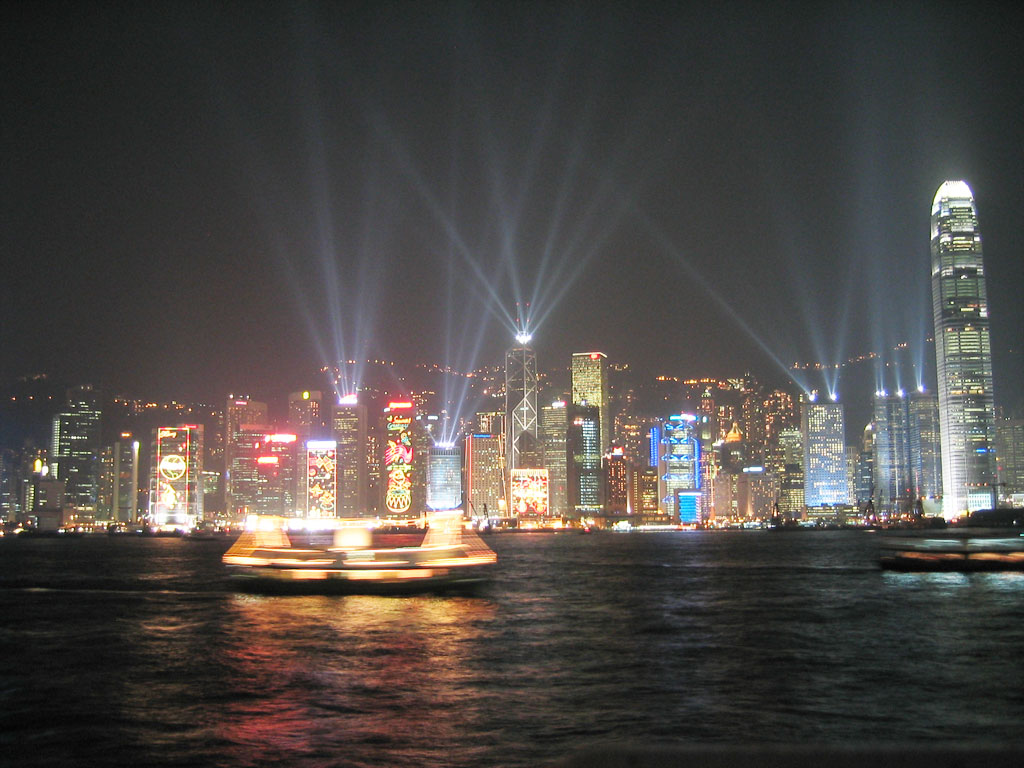
At night we made a few pictures at the harbour which was quite beautiful.